Enhancing reading performance through action video games: the role of visual attention span
Abstract
Recent studies reported that Action Video Game-AVG training improves not only certain attentional components, but also reading fluency in children with dyslexia. We aimed to investigate the shared attentional components of AVG playing and reading, by studying whether the Visual Attention (VA) span, a component of visual attention that has previously been linked to both reading development and dyslexia, is improved in frequent players of AVGs. Thirty-six French fluent adult readers, matched on chronological age and text reading proficiency, composed two groups: frequent AVG players and non-players. Participants performed behavioural tasks measuring the VA span, and a challenging reading task (reading of briefly presented pseudo-words). AVG players performed better on both tasks and performance on these tasks was correlated. These results further support the transfer of the attentional benefits of playing AVGs to reading, and indicate that the VA span could be a core component mediating this transfer. The correlation between VA span and pseudo-word reading also supports the involvement of VA span even in adult reading. Future studies could combine VA span training with defining features of AVGs, in order to build a new generation of remediation software.
Introduction
Action video games (AVGs) and books
are very different and yet, the visual processes involved in playing AVGs and in reading a book could be closely linked. The former display complex scenes, sophisticated geometric rendering and rapid moving objects, whereas the latter contain black and white static print, usually in a single alphabet and font. However, Franceschini et al.1,2 showed a positive effect of AVG training on reading in dyslexic children (see also Gori et al.3). A group of children played AVGs for twelve hours. After training, they significantly improved both their visual attention and their reading speed, without loss of reading accuracy. This observation is puzzling. How could an off-the shelf AVG have such an impact on reading performance? Could AVGs be used to improve reading speed, without specifically targeting verbal material?
There are several possible links between AVG playing and reading. AVGs are defined by high speed events and fast moving targets, spatial and temporal unpredictability, an emphasis on the peripheral visual field, and high motor, perceptual and cognitive loads4. They are one of the most studied classes of video games because of their positive effect on various cognitive and perceptual processes. For example, AVG players are better in contrast discrimination5, probabilistic inference6 and mental rotation tasks7. The features of AVGs set up high attentional requirements to succeed at the game, so we could assume that playing AVGs specifically trains visual attention. And indeed, it does: the causal link between AVG practice and improvement of visual attention has been assessed in many studies8,9 (for a review see ref.4). Visual attention covers a large number of dimensions, so that AVGs affect many different tasks. To name a few, AVG players are better at visual search10,11, in enumeration tasks and in multiple-object-tracking tasks9. They also are less susceptible to crowding effects12 (for a review see ref.13). Interestingly, individual improvement in reading performance was correlated with improvement in visual attention in the studies by Franceschini et al.1,2.
Temporal and spatial visual attention is enhanced in AVG players. Their higher performance on tests of visuo-attentional skills (enumeration, multiple-object-tracking) was attributed to spatial attention improvement13. This is in particular exemplified by their ability to track more objects simultaneously than non players14. Other findings suggest positive effects on the temporal dimension of visual attention. This is in particular exemplified in the attentional blink paradigm in which a stream of letters is briefly displayed, one after the other, and participants have to quickly shift from one letter feature (the colour of a first target) to another (the identity of a second target). The momentary blink in attention, observed when the second target occurs in the few hundred milliseconds following the coloured letter, is reduced in AVG players, suggesting faster temporal processing skills than in non players8. It is thus well established that AVGs improve several facets of attention and that AVG players benefit from greater attentional resources.
On the other hand, many studies have shown that visuo-attentional skills are involved in normal15,16 and pathological reading17,18. Our previous findings, in particular, emphasized the link between the visual attention (VA) span and reading performance19,20,21,22,23. VA span is defined as the number of distinct visual elements (i.e., letters, in a reading context) that can be simultaneously processed in one fixation24. The size of the VA span reflects the amount of attention capacity that is available for multi-element processing25,26 and is linked to superior parietal lobule (SPL) activation for pre-lexical orthographic processing27,28,29. In typical children/teenagers, a larger VA span relates to faster and more accurate reading19,20. A large VA span helps readers to process larger orthographic units21,30. Individuals with a large VA span can process most familiar words and within-unfamiliar-words longer sub-lexical units (multi-letter graphemes or syllables) as a whole, which results in higher reading speed. Thus, children with higher VA span process more letters at each fixation and show faster text reading31. The impact of VA span on text reading further holds for adult readers32. The contribution of VA span to pseudo-word reading is independent of phonological skills in typical readers19 and a subset of dyslexic children exhibits a VA span deficit and poor pseudo-word reading despite good phonological skills22,23,24,33.
Some authors argue that VA span impairment would be the consequence of the poor reading skills of dyslexic readers34 but evidence from longitudinal and training studies speaks against such a consequence link35. The VA span of pre-readers predicts their future reading performance36. In pure visual attention span dyslexia, VA span training has a significant impact on reading speed37,38. The fact that the VA span is involved in non-verbal tasks and non-verbal material25,28,39 is further evidence against any interpretation that the VA span-reading relationship is mediated by language or reading experience. Furthermore, the VA span deficit in developmental dyslexia is not restricted to horizontal reading-like displays. Children showing VA span limitations on horizontal letter strings are similarly impaired when using circular displays26,40. They further show a deficit in visual search tasks for spatially distributed stimuli, which strongly speaks against specialization for reading and/or horizontal array processing41. Because the VA span is not restricted to verbal stimuli, and because it is not restricted to mono-dimensional stimuli, it could also be used by players when processing visual stimuli presented by an AVG.
Overall, AVG playing affects the spatial distribution of attention over the visual scene so that a larger deployment of attentional resources helps AVG players to process more visual information simultaneously. On the other hand, children with higher VA span have greater attentional resources which they deploy more widely to process more letters simultaneously within strings, leading in turn to faster and more accurate reading. When put together, these results strongly suggest that the VA span might be a common component between playing AVGs and reading. AVG playing might enlarge the players’ VA span, which would help them process larger multi-letter units, and consequently, would improve their reading performance. The main aim of the current study is to test this hypothesis. Two groups of AVG players and non-video game (NVG hereafter) players were recruited; they were matched on chronological age and text reading proficiency. We assessed their VA span abilities (i.e., their ability to process multiple elements simultaneously) using classical partial and global report paradigms. During partial (or global) report, a 6-consonant string is briefly presented to the participant. One string position (or none) is cued at each trial, and the participant has to name the cued letter only (or the whole sequence). Single letter identification skills were further assessed to ensure that differences in performance on the letter-string report tasks were not explained by differences in single letter processing. Finally, we tested the participants’ ability to read briefly presented 6-letter pseudo-words (PW) made of units of different sizes. AVG players were expected to show larger VA span and more accurate PW reading; they should also be more sensitive to larger PW sub-lexical units than non-players.
Results
Visual Attention Span Tasks
Global Report
Performance of the two groups of participants in global report is illustrated in Fig. 1 and descriptive data is provided in Supplementary Table S1.
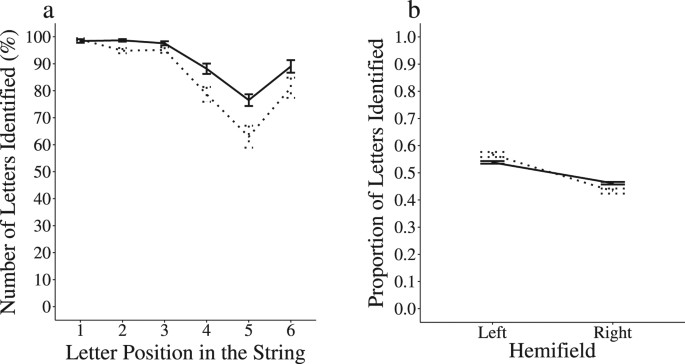
Global report task - Letter identification by position (1a) and left-right hemifield relative performance (1b) for the AVG players ( ) and non-players (
 ). Error bars represent one standard error.
) and non-players (). Error bars represent one standard error.
In the global report task, participants were asked to report as many letters as possible from 24 6-letter strings presented successively at the centre of the screen for 200 ms. The percentage of letters accurately identified by position in the AVG (n = 19) and NVG (n = 17) groups is illustrated in Fig. 1a. A Type III ANOVA was performed on the original data with Group (AVG vs. NVG) as the between-subject factor and Letter Position as the within-subject factor (Positions 1–6). There was a main effect of Group (F(1, 34) = 11.35, p = 0.002, ηp 2 = 0.25) and a main effect of Letter Position (F(5, 170) = 24.38, p < 0.001, ηp 2 = 0.68). The AVG group identified more letters accurately than the NVG group (M(SD) = 91.41 (4.41) % vs. M(SD) = 85.29 (6.4) %). The Group by Letter Position interaction was significant (F(5, 170) = 4.04, p = 0.002, ηp 2 = 0.45). Post hoc comparisons on the Group by Letter Position interaction indicated that the AVG and NVG groups performed similarly on the three first positions of the string (Positions 1, 2 and 3; all ps > 0.19), but the AVG group identified more letters accurately on Position 4 (β = 9.48, t = 3.2, p = 0.002), Position 5 (β = 13.54, t = 4.57, p < 0.001) and Position 6 (β = 7.91, t = 2.67, p = 0.008).
We reasoned that better parallel processing in AVG players would result in a more homogeneous spreading of visual attention across the whole string, thus resulting in more balanced identification of letters across the hemifields. To test this hypothesis, a left-right hemifield comparison was performed while equating for the two groups overall performance on the task. The percent average accuracy of participants to the left (positions 1, 2, and 3; left hemifield) and right of fixation (across positions 4, 5, and 6; right hemifield) were computed. These scores were then divided by the participant’s mean percent score, across all positions. Thus, the sum of both scores for each participant was 1. Therefore, the “Hemifield” scores represented the relative performance on each hemifield for each participant, regardless of their overall accuracy, thus reflecting their visual attention distribution strategy over the string. Hemifield effects on global report performance are illustrated in Fig. 1b. A Type III ANOVA was performed on the original data with Group (AVG vs. NVG) as the between-subject factor and Hemifield as the within-subject factor. As expected, there was no main effect of Group (F(1, 34) = 0, p = 1, ηp 2 = 0) due to the normalized scores used (see above). There was a main effect of Hemifield (F(1, 34) = 29.96, p < 0.001, ηp 2 = 0.47) and a Group by Hemifield interaction (F(1, 34) = 8.11, p = 0.007, ηp 2 = 0.19). The post hoc comparisons on the Group by Hemifield interaction indicated that in both Groups, participants responded more accurately to letters presented in the left as compared to the right hemifield (AVG: β = 0.08, t = 7.74, p < 0.001; NVG: β = 0.13, t = 12.87, p < 0.001). Moreover, the NVG participants had a relative performance score above that of the AVG participants on the left hemifield (AVG-NVG: β = −0.03, t = −2.85, p = 0.006) but below that of the AVG participants on the right hemifield (AVG-NVG: β = 0.03, t = 2.85, p = 0.006). This suggests a stronger left bias for the NVG than the AVG participants.
If more widely spread across the letter string, higher attentional resources would further result in lesser inter-position variability on letter identification. The correlation between individual standard deviation scores (reflecting individual inter-position variability in performance on the global report task) and individual mean percent scores across all positions on the global report task was significant both across the whole group of participants (n = 36, τb = −0.77, p < 0.001), and within each group of participants (AVG (n = 19): τb = −0.78, p < 0.001; NVG (n = 17): τb = −0.73, p < 0.001, see Supplementary Fig. S1). This indicates that smaller variability related to better overall performance on the tasks. In particular, the AVG group showed lower by-position variability in performance than the NVG group (AVG: M(SD) = 8.9 (3.29), NVG: M(SD) = 13.81 (5.98), t = −3.01, df = 24.25, p = 0.006).
Partial Report
In the partial report task, the participants were successively presented 72 6-letter strings briefly (200 ms) in the centre of the screen. After the presentation of each string a retro-cue indicated which letter they should report from the presented string. The percentage of cued letters accurately identified by position in the AVG (n = 19) and NVG (n = 17) groups is illustrated in Fig. 2 and descriptive data is provided in Supplementary Table S2. A Type III ANOVA was performed on the original data with Group (AVG vs. NVG) as a between-subject factor and Letter Position as a within-subject factor (Positions 1–6). There was a main effect of Group (F(1, 34) = 6.28, p = 0.017, ηp 2 = 0.16) and a main effect of Letter Position (F(5, 170) = 8.70, p < 0.001, ηp 2 = 0.55). As in global report, the AVG Group identified significantly more letters than the NVG Group (M(SD) = 88.38 (5.95) % vs. M(SD) = 79.74 (13.66) %) but the Group by Letter Position interaction was not significant (F(5, 170) = 1.09, p = 0.36, ηp 2 = 0.27), meaning that the AVG players’ advantage was similar across the six positions.


No hay comentarios:
Publicar un comentario
Aportes